
Dr. Samuel Drapeau
上海交通大学
Speaker: Dr. Samuel DrapeauTime: 12:30-13:30, 21 December 2021 (Tuesday) (Beijing time)Venue: C404, Lijiao Building, BNU at ZhuhaiAbstract
Abstract 摘要
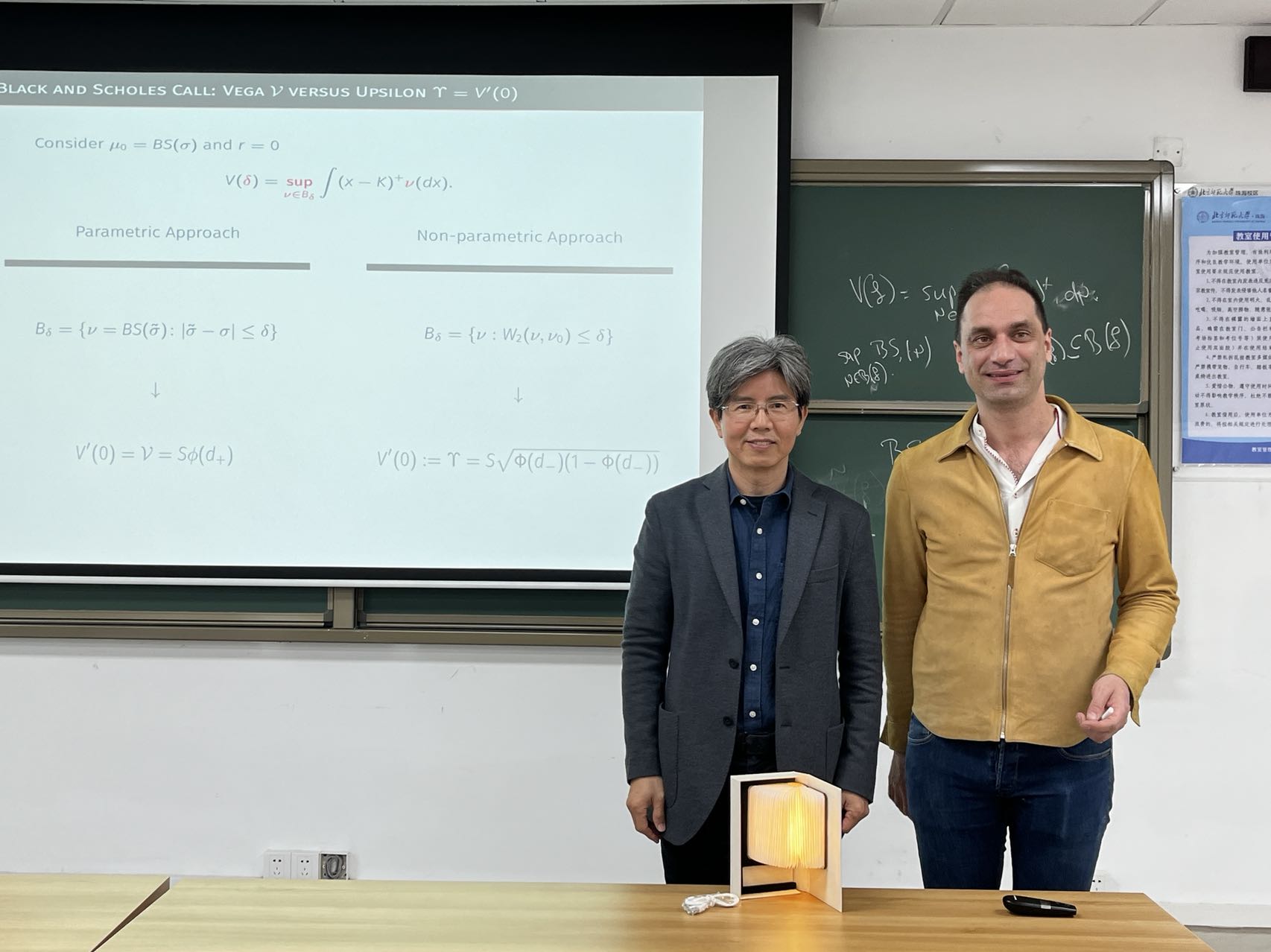
In this talk, we will showcase how methods from optimal transport and distributionally robust optimisation allow to capture and quantify sensitivity to model uncertainty for a large class of problems.We consider a generic stochastic optimisation problem. This could be a mean-variance or a utility maximisation portfolio allocation problem, a risk measure computation, a standard regression or a deep learning problem. At the heart of the optimisation is a probability measure, or a model, which describes the system. It could come from data, simulations or a modelling effort for which there is always exists a degree of uncertainty.

We take a non-parametric approach and capture model uncertainty using Wasserstein balls around the postulated measure. Our main results provide explicit formulae for the first order correction to both the value function and the optimiser. We further extend our results to optimisation under linear constraints. Our sensitivity analysis of the distributionally robust optimisation problems finds applications in statistics, machine learning, mathematical finance and uncertainty quantification. In the talk, we will discuss several financial examples anchored in a one-step financial model and compute their sensitivity to model uncertainty.

These include: option pricing, mean-variance portfolio selection, optimised certainty equivalent and similar risk assessments. We will also address briefly some other applications, such as explicit formulae for first-order approximations of square-root LASSO and square-root Ridge optimisers and measures of NN architecture robustness wrt to adversarial data.

This talk is based on joint works with Daniel Bartl, Jan Obloj and Johannes.
Highlights(精彩看点)