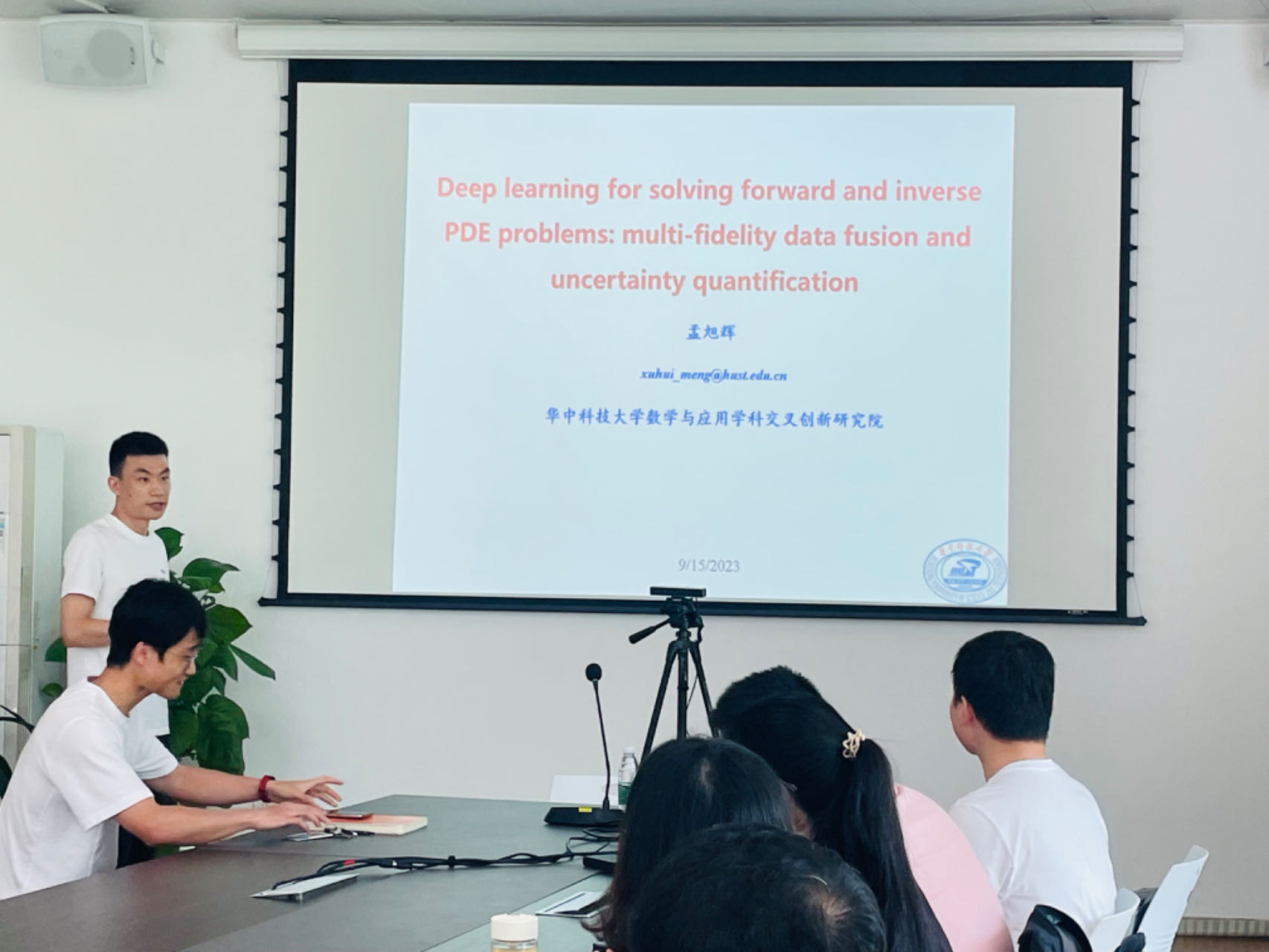

Dr. Xuhui Meng (孟旭辉博士)
华中科技大学
2017年博士毕业于华中科技大学能源与动力工程学院;2018年-2022年美国布朗大学应用数学系博士后;2022年3月至今任华中科技大学数学与应用学科交叉创新研究院副教授。
Abstract 摘要
Deep learning algorithms have emerged recently for solving partial differential equations (PDEs), especially in conjunction with sparse data. In particular, the recently developed physics-informed neural networks (PINNs) have shown their effectiveness in solving both forward and inverse PDE problems. Different from the classical numerical methods in which the differential operators are approximated by the data on certain discrete lattices (meshes), PINNs compute all the differential operators of a PDE using the automatic differentiation technique involved in the backward propagation. Consequently, no mesh (structured mesh or unstructured mesh used in the classical numerical methods) is required for the PINN to solve PDEs, which saves a lot of effort in grid generation. Another attractive feature is that PINNs are capable of solving the inverse PDE problems effectively and with the same code that is used for forward problems. In this talk, I will introduce several newly developed PINNs for solving forward and inverse PDE problems as well as their applications: (1) reconstructions of multiscale flow fields via PINNs; (2) multi-fidelity PINNs for inverse PDE problems with multi-fidelity data; and (3) uncertainty quantification in PINNs.
Speaker Biography 讲者简介
2017年博士毕业于华中科技大学能源与动力工程学院;2018年-2022年美国布朗大学应用数学系博士后;2022年3月至今任华中科技大学数学与应用学科交叉创新研究院副教授。主要研究方向为数据驱动的深度学习建模及其应用。截至目前已在JCP、CMAME、SIAM Review等期刊发表SCI论文20余篇,谷歌学术总引用3000余次,5篇论文入选ESI高被引论文,担任JCP、SISC、CMAME、Nat. Comput. Sci .等期刊审稿人。
Highlights(精彩看点)